
Frogs!!!

We have been having quite a spring clean here at Woodleigh with our buckets, brooms and gloves. Weeding, pruning, controlling liverwort with baking soda (yes it works) and shifting plants around.
This is when we discovered our little friends hiding amongst the plant pots. Frogs! Big ones, little ones, green and brown ones, we had to be quite careful not to stand on them. They weren’t that happy with us moving their homes around so we shifted a few to the old cow trough (now fish pond).

Frog at Woodleigh Nursery
We use very few chemicals in our nursery (hence the use of baking soda as we look for alternatives). Frogs are very sensitive to chemicals so it has been exciting and rewarding to see so many; it indicates to us that we run a fairly environmentally friendly nursery. Each year we see a few, this year we have certainly seen the most.
Spring is definitely here now.
Our Rosa Roseraie de L’Hay is in flower with its scent wafting around the nursery. This is one of the best rugosa roses, with large, double, wine-purple flowers and a strong perfume. It repeat flowers well.
The Leucothoe fontanesiana is smothered with masses of cascading white Pieris like flowers at the moment. This plant comes from southeastern USA. It is a very easy care plant, providing a beautiful floral display through spring and summer.
Purple anise, Illicium floridanum is another flowering shrub from the southeastern USA. The starry red wine coloured flowers have a heady port-like fragrance. Another easy care shrub with tough waxy leaves.
The macrophylla hydrangeas are bursting into lush growth now with many starting to show flower buds. The new season is upon us.
Janica
October 2014
Janica and Quin Amoore Woodleigh Nursery 300 Mountain Road RD 3 New Plymouth 4373
Tel 06 752 0830 | Cell 021 072 7394 (phone or text) | Email janica@woodleigh.co.nz
Hydrangea Pruning
Yes it is that time of year again, the time for winter pruning; a job that both Quin and I really enjoy. In our earlier life when we had an Arboricultural (Tree Surgery) business. We covered the full range of pruning from large trees, shrubs, to fruit trees, roses and even hydrangeas (those were the jobs I loved).
The winter here has been very mild, confusing for many of our plants. Recently though, we have had a few really good frosts, followed by gorgeous sunny days. It has been a good winter chill to kill some of those bugs, and hopefully delay the spring growth. I just want to get out into the garden to start the winter pruning and renovation – remove some of those unwanted plants to make room for new plantings.
We are sometimes asked ‘Why do we prune?’ & ‘Do we have to prune?’
There are 3 reasons that we like to prune plants:
- To remove dead and diseased wood.
- To improve or maintain the shape of a plant
- To increase flowering and fruiting – when pruning hydrangeas we aim to reduce the number of individual flower heads, enabling the plant to produce larger better quality flowers.
No it is not essential that you prune your hydrangeas each year. The new growth will emerge and eventually smother the old flowers. The bush will be covered in many small flowers.
Now is a good time to prune your hydrangeas; though if you are in an area that receives late spring frosts you may like to wait a few more weeks.
Winter pruning of Hydrangea macrophylla and Hydrangea serrata types:
- Remove all dead, damaged or diseased material
- Remove thin, spindly, crossing or crowding stems
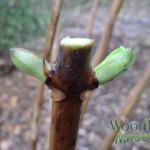
- Reduce the height of the remaining strong stems, keeping 1 – 2 pairs of fat flower buds.


The flower buds are usually in pairs near the top of the stem and vary in size with different varieties. The leaf (growth) buds are below these and are smaller in size.
The Hydrangea paniculata types like to be treated differently. These do need to be pruned each winter, and pruned quite hard to ensure that the plant puts out strong stems that can carry the heavy flower heads.
For the first 3 years after planting prune to create a strong framework of 3 or 4 strong stems in a vase shape. In subsequent winters remove all growths back to the base shape leaving 2 or 3 buds at the base of each stem.
Happy pruning.
Janica
August 2014
Janica and Quin Amoore Woodleigh Nursery 300 Mountain Road RD 3 New Plymouth 4373
Tel 06 752 0830 | Cell 021 072 7394 (phone or text) | Email janica@woodleigh.co.nz
A Late Summer Display

The majority of our Hydrangea macrophylla’s in the stock beds are now displaying their autumn tones in a range of colours from pale greens and metallic blues through to maroons and wine-reds. One exception is H. ‘Gartenbaudirektor Kuhnert'(don’t be put off by the name – let’s just call it Gartenbau). This photo was taken yesterday in our garden. The plant is in its second season, and is still establishing. It flowered earlier in the season (January) and is flowering again now. This is usual for this variety often providing a heavier display in autumn which extends through to early winter. In Glyn Church’s garden I have seen it still providing a colourful display in late June / July.
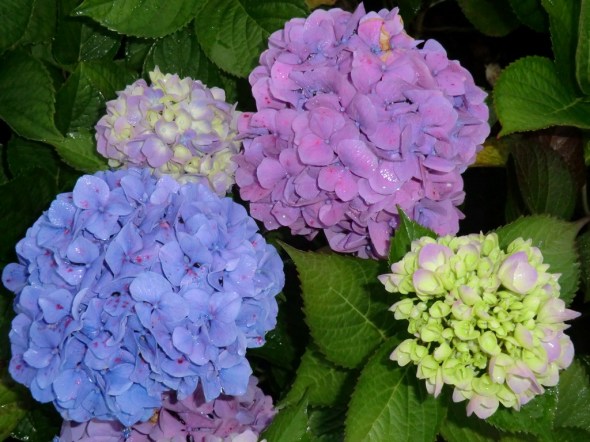
Hydrangea macrophylla Gartenbaudirektor Khuhnert
Janica and Quin Amoore Woodleigh Nursery 300 Mountain Road RD 3 New Plymouth 4373
Tel 06 752 0830 | Cell 021 072 7394 (phone or text) | Email janica@woodleigh.co.nz
 Woodleigh Nursery